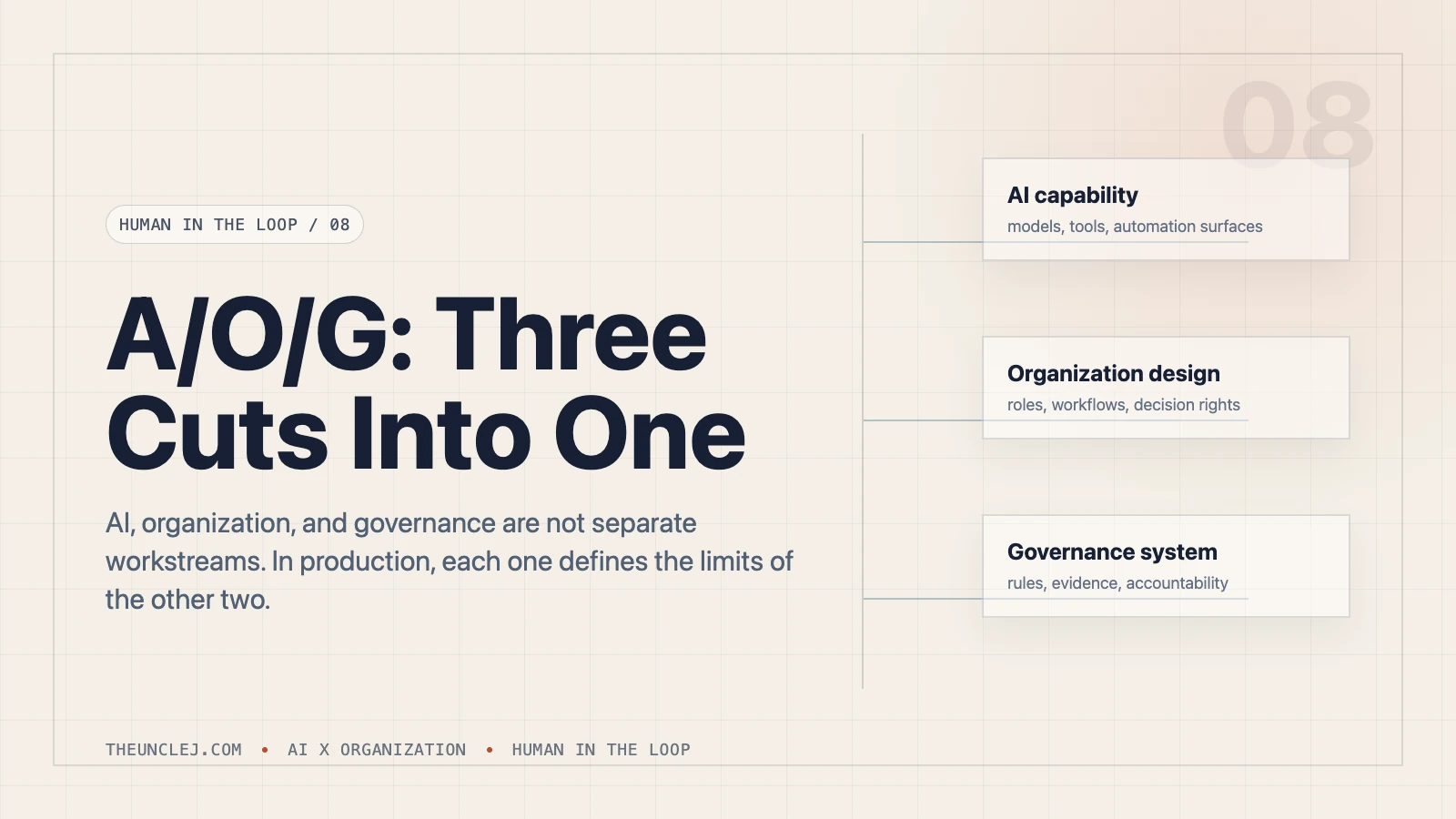
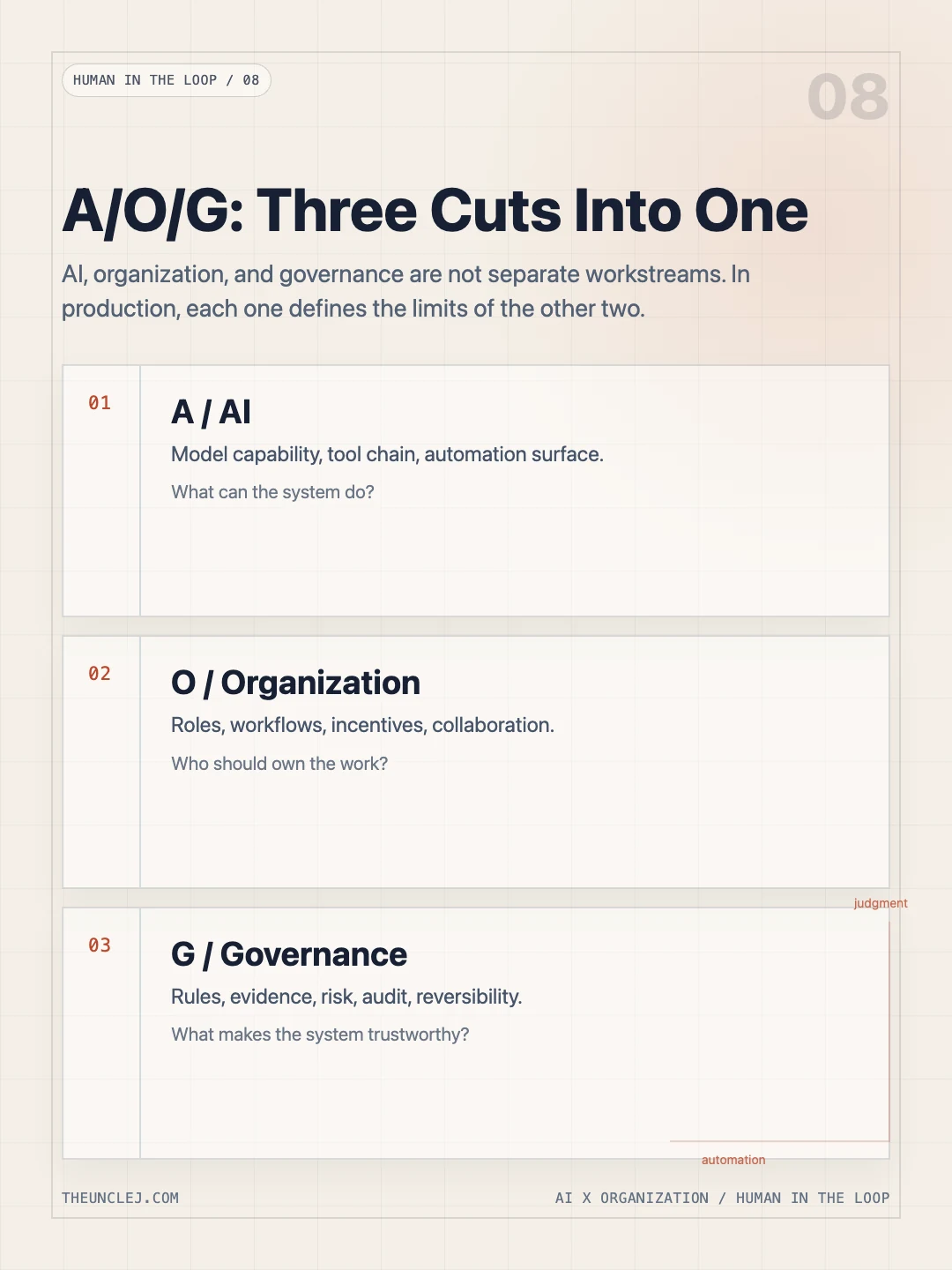
A/O/G: Three Cuts Into One
This is Part 8 of the Human in the Loop series.
Do not start by asking which AI to buy
By the end of Part 7, the question had already mutated. It was no longer "what is an FDE." It was "where does the organization make the first cut."
FDE is an organization interface. It carries judgment from the customer site into the production system, and carries field knowledge back into the platform. But the moment a CEO actually walks into the meeting room, a more pedestrian question shows up. Where do we start.
Most CEOs ask this question wrong.
They ask: which AI should we buy. Which model should we plug in. Should we hire AI engineers. Do we need agents. None of these are wrong questions. None of them are the first question. The first question is which knife this round of AI transformation should pick up.
The three letters A/O/G originally pointed at three companies: Anthropic and Claude, OpenAI, Gemini and Google. That external anchor is fair, because all three are publicly exposing different cross-sections of enterprise AI. But for a CEO, you cannot stop at "what each of those companies is doing."
So in this essay I am translating those three signals into three organizational knives.
A is Action. The action cut. It cuts concrete actions: writing, looking up, generating, organizing, replying, pre-staging an approval, doing the first pass on data. It answers: which actions can AI take over, and which actions must keep a human in the judgment seat.
O is Organization. The organization cut. It cuts the rearrangement of roles, flows, knowledge, and accountability. It answers: after AI walks in, whose work changes, whose authority changes, whose accountability changes, and whose capability has to be redefined.
G is Governance. The governance cut. It cuts permissions, audits, boundaries, evaluations, pauses, and rollbacks. It answers: once AI is genuinely in production, who lets it act, who can stop it, who can investigate when something breaks, and who signs off.
These three words are not industry standard terms. They are a naming choice for this campaign, made for one purpose — to help the person at the top decide. The outside world has already scattered the fragments. Anthropic is publicly studying how its own internal work is being rewritten by Claude Code. OpenAI is talking about deployment, FDEs, frontier alliances, and workforce blueprints. Google Cloud is talking about the five steps from pilot to production. YC is talking about how AI-native companies organize themselves.
But a CEO cannot treat these fragments as a menu.
You are not in Silicon Valley ordering off a menu. You are operating on your own company.
Cut wrong with the action knife and AI will amplify low-value busywork. Cut wrong with the organization knife and the role titles change while the accountability chain does not. Cut wrong with the governance knife and the faster the front end runs, the more dangerous the back end becomes.
So this essay does not introduce a new concept.
It introduces a single judgment sequence: how A/O/G fits together as one cut.
A cut: cut the actions first
The action cut is the easiest to understand and the fastest to show results.
Companies are full of actions that are inherently low-judgment, high-repetition, easy to verify, easy to roll back. Cleaning up meeting notes, drafting first versions, extracting information, rewriting copy, retrieving documents, reconciling numbers, generating sales material, turning a pile of unstructured material into a structured table. These actions used to consume people not because they were sophisticated, but because the system was too expensive, the tools were too clunky, and the organization had no other choice.
Once AI walks in, these actions should be repriced first.
Anthropic's internal research is a useful sample for the action layer. The study surveyed 132 engineers and researchers, ran 53 in-depth interviews, and analyzed 200,000 internal Claude Code usage records. What it saw was not "engineers disappear." What it saw was a large set of action boundaries being redrawn — bug fixing, navigating an unfamiliar codebase, generating implementations, learning a new module — all accelerated by Claude Code.
But the same study draws a hard boundary around the action knife.
Anthropic is explicit: most employees report that only 0–20% of their work can be "fully delegated." Claude is a high-frequency collaborator, but high-stakes work still requires active supervision and verification. In other words: actions can be handed to AI. Judgment cannot be casually thrown away with them.
When the CEO looks at the action knife, the question to ask is not "can this role lose a headcount."
It is four action questions.
One. Which actions are repetitive enough to be standardized.
Two. Which actions produce output that is cheap to verify.
Three. Which actions, if they go wrong, can be paused or rolled back.
Four. Which actions look repetitive but carry customer trust, compliance boundaries, or business judgment underneath, and therefore cannot be handed directly to AI.
Cut the action knife well and the company releases time immediately. Employees stop wasting half a day on organizing, moving, rewriting, and looking things up. Cut the action knife badly and the company simply amplifies low-quality actions tenfold.
This is also the easiest mistake for a CEO to make.
Seeing that AI can generate, they assume it can deliver. Seeing that AI can reply, they assume it can be accountable. Seeing that AI can write code, they assume it can ship to production.
The action knife only answers one question: can this action be performed by AI.
It does not answer: should this action be performed at all.
A cut pitfall: action automation is not organizational upgrade
Cutting only actions produces a particular illusion in the CEO: the company has gone AI.
Chat groups fill with AI-generated daily reports. Sales starts using AI to write follow-up messages. Marketing pumps out AI-generated content at volume. Engineering lets AI write code. HR uses AI to clean up interview notes. Everyone is using AI. Tool activity looks great. The CEO can stand up in a meeting and say "we have fully embraced AI."
This is not organizational upgrade.
Action automation just makes the old organization run faster. If the old flow was messy, AI makes the mess move faster. If accountability was fuzzy, AI makes blame-shifting faster. If knowledge lived in the heads of long-tenured employees, AI gets better at cleaning up the surface material — but it does not automatically turn deep judgment into organizational capability.
This is exactly why Part 6 kept hammering on the judgment premium.
Once actions get cheap, actions stop being valuable. The valuable question becomes: which actions should be kept, which should be cancelled, which should be merged, which actions are actually judgment nodes in disguise, and which actions — once amplified by AI — drag the company into the risk zone.
Take sales follow-up.
AI can write a hundred versions of an outreach message. That is action capability. The real question is: which customers should not be hit at high frequency, which commitments must never be auto-written into an email, which price boundaries cannot be left to the model's discretion, which complaints must be escalated to a named owner. Cut only the action and the sales team turns into a content flood. Cut into the organization and you start rewriting lead grading, customer tiering, approval rights, and exception handling.
Take R&D.
AI can generate code. That is action capability. The real question is: which code can be tried fast, which code must be reviewed, which services have production permissions, who owns rollback, who defines test thresholds. Cut only the action and you get more code. Cut into the organization and you start rewriting the development flow, review accountability, deployment gates, and incident postmortems.
So the action knife has a ceiling.
It is good for opening the situation. It is not good for closing it.
If the CEO only wants AI for "productivity gains," the action knife is enough. If the CEO wants AI to enter the operating system of the business, the action knife is only the first cut. The next cut has to go into the organization.
O cut: then cut the organization
The organization cut is harder than the action cut, because it does not just change tools.
It changes how the company divides labor.
OpenAI's public material already says this out loud. In Frontier Alliances, OpenAI writes that the limiting factor on enterprise AI value is not just model intelligence, but how agents are built and run inside organizations. Alliance partners help customers define strategy, integrate systems, redesign workflows, and scale deployment. The Frontier page also says FDEs work with customer teams to design architecture, run governance, get agents running in production, and build repeatable patterns the customer's own team can own and extend.
Put those words side by side. This is no longer "buy a tool."
Strategy, systems integration, workflow redesign, governance, production operation, repeatable patterns — these all belong to the organization cut.
The first layer the organization knife cuts is roles.
Once AI walks in, most roles do not vanish on day one. But the actions inside the role get pulled apart. An operations person used to spend 70% of their time organizing and moving things, and 30% of their time judging and coordinating. Once AI absorbs the first 70%, does the role get compressed or upgraded? The answer is not inside the model. The answer is in how the CEO rewrites the role.
The second layer the organization knife cuts is flows.
Old flows pushed humans into systems. New flows often invert: AI runs first, the human judges at the critical nodes. Approval, delivery, customer response, exception escalation, postmortem — all of it has to be redesigned. Without redesign, AI is just an external attachment bolted onto the old flow.
The third layer is knowledge.
The old organization's knowledge lives in people, documents, chat groups, and lived experience. Once AI walks in, knowledge has to become an asset that is retrievable, callable, updatable, and evaluable. Otherwise AI eats fragmentary material and gives back answers that sound reasonable but never quite touch the ground.
The fourth layer is accountability.
Who lets AI act. Who approves the critical actions. Who catches the exceptions. Who changes the rules. Who carries the consequences. If these questions do not get rewritten back into the organization, then the faster actions get automated, the harder the postmortem gets.
So the essence of the organization cut is this: convert AI capability from an individual technique into a corporate division of labor.
If this cut never lands, AI stays stuck forever in the "everyone is using tools" theater.
O cut pitfall: do not copy-paste the AI-native company
The organization knife is most often pulled off course by one specific temptation: copy-paste the AI-native company.
YC's AI-native company playbook is genuinely valuable. It compresses how a startup rewrites organization, product, growth, and engineering around AI. For a team building from zero, this material is sharp, because it is written for new companies: no historical baggage, no complex hierarchy, no decade-old process debt, no large pool of legacy roles that need to be relocated.
But traditional Chinese enterprises are not building from zero.
This is the most important difference.
A traditional enterprise is not a blank sheet. It has old customers, old systems, old flows, old budgets, old managers, old reporting lines, old performance reviews, old culture. An AI-native company can write AI into its operating system on day one. A traditional enterprise has to swap the engine on a machine that is already running.
So the organization cut cannot be copy-pasted.
When an AI-native company says "hire fewer people, burn more tokens," that may hold for a startup. If a traditional enterprise copies it directly, it usually turns into crude headcount cuts, broken handoffs, and customer experience that swings wildly. An AI-native company can let a handful of strong operators punch one workflow through end to end. A traditional enterprise has to handle cross-functional coordination, permission approvals, compliance trails, and knowledge transfer out of older employees.
What CEOs should actually learn is not the surface moves of AI-native companies.
What they should learn is the underlying organizational principle: actions get pulled apart first, judgment gets repriced, flows get rearranged around the AI-human seam, knowledge sediments into a system, and accountability stops living in the spoken word.
This is also why I do not advise Chinese enterprise CEOs to march in shouting "we are going to become AI-native."
That sentence is too big. It collapses into a slogan too easily.
The more grounded question is this. Which of our old flows are worth rewriting. Which of our old roles are worth upgrading. Which of our old knowledge has to be systematized. Which of our old accountability chains has to be rewired.
The organization cut is not about turning your company into a Silicon Valley startup.
The organization cut is about pulling your own company out of an outdated division of labor.
G cut: cut governance last
The governance cut is the least sexy. It is also the one that decides whether you live or die.
Because once AI is actually in production, the question is no longer "can it do it." The question is "by what right does it do it."
By what right does it read this data, by what right does it send this message, by what right does it modify this table, by what right does it call this API, by what right does it move a customer into a particular tier, by what right does it recommend rejecting a transaction, by what right does it auto-escalate a complaint.
Those "by what right" questions are the governance cut.
Google Cloud's February 2026 piece on moving from pilot to production puts this in very practical terms. Many organizations are slamming into AI sprawl — uncoordinated strategy leading to fragmented workflows, governance risk, and models that cannot take root in real enterprise context. Its five-step framework is not just technology choice. It covers enterprise truth, task not chat, fast iteration, agent sprawl interop, and outcomes not activity.
Translate that into CEO language and you get the governance cut.
One. Data governance. AI cannot live on static files and stale documents. It needs trustworthy, current, traceable enterprise truth. Otherwise the better the model talks, the more its mistakes look like truth.
Two. Permission governance. Each agent's ability to read, act, and call tools must have boundaries. Without boundaries, AI silently misreads "an employee is allowed to access this" as "the system can act on this automatically."
Three. Evaluation governance. The company cannot stare at usage counts. It has to ask which functions shortened cycle time, reduced rework, lowered errors, lifted customer outcomes. Activity data is not business outcome.
Four. Exception governance. AI will make mistakes. The question is not whether errors can be eliminated, but when they appear, who notices, who can pause, who can roll back, who can do the postmortem.
Five. Accountability governance. AI is not a legal entity. AI is not an employee. The person who signs off, the person who authorizes, the person who reviews, the person who lets it go to production — all of them must leave a trail inside the system.
Many CEOs do not like to start with the governance cut, because governance looks slow.
But high-consequence scenarios must start with governance. Finance, healthcare, production systems, customer commitments, pricing authority, compliance boundaries — none of these can be opened up first by enthusiasm. The higher the consequence, the more the boundary has to be asked first.
The governance cut is not the brake on innovation.
The governance cut is what lets the company hit the accelerator.
Three cuts into one: not a fixed template
The most important thing about A/O/G is not three checklists. It is the order of judgment.
Low-risk, high-frequency, easily verifiable scenarios — cut A first.
Internal material organization, sales drafts, meeting notes, candidate profile summaries, knowledge base retrieval. Cut the action knife first here and you release time fast while the organization accumulates real AI usage experience. The key is to not let an action victory get inflated into an organizational victory.
Cross-functional, cross-process, cross-role scenarios — cut O first.
Customer delivery, sales-to-operations handoff, R&D-to-production, HR-to-business, finance-to-procurement. If you only drop a tool into these scenarios, every department usually ends up playing its own game. You have to rewrite who inputs, who judges, who approves, who catches exceptions, who sediments the knowledge. Otherwise AI just helps each department produce its own version faster.
High-consequence, high-authority, high external impact scenarios — cut G first.
Customer commitments, compliance judgments, production system changes, pricing approvals, money movement, public statements. These places cannot be opened up by "let us try and see." You must define permissions, audit, evaluation, pause, and rollback up front. If governance is unclear, the faster actions move, the more risk concentrates.
Most AI transformations fail not because the company bought the wrong tools. They fail because the order was reversed.
The place that needed governance first got the action knife instead. The place that needed organization first got a SaaS subscription. The place that needed the action knife first got dragged into a strategy meeting that complicated something simple.
So A/O/G is not a maturity model.
It is a surgical table.
You cannot use the same knife on every lesion. You cannot treat one knife's quick win as the whole operation.
This is exactly where the judgment of the person at the top shows up.
You have to know whether this round of AI transformation is really about action cost being too high, about the organizational interface being broken, or about governance boundaries being missing. Judge wrong and AI will not save you. AI will amplify whatever is wrong.
A three-cut meeting for the person at the top
Let me leave you with one meeting agenda.
The next time you run an AI transformation meeting, do not let the vendor present first. Do not let the tech team open with the model. Do not let every department line up and report "how much AI we used."
Run the three cuts through first.
First cut, A. Which three high-frequency actions will be handed to AI this month?
Each action has to be written out clearly: what is the input, what is the output, who verifies, what happens when it breaks, where does the released time go. If those cannot be answered, do not talk about scaling.
Second cut, O. Once this action is handed to AI, which role, which flow, which knowledge node, which accountability line has to be rewritten?
If an action gets replaced but the reporting lines, the performance reviews, the approvals, and the handoffs all stay the same, the organization will not upgrade. It will just generate new friction.
Third cut, G. Does this scenario have to go through the governance gate first?
The moment customer commitments, production permissions, compliance boundaries, money, pricing, or public expression are in play, ask the permission, log, audit, pause, and rollback questions first. If governance cannot answer, choose slow over reckless speed.
Run those three cuts. Only then decide what to buy, who to hire, which model to plug in.
The order cannot be reversed.
Buy the tool first, the features lead you around by the nose. Hire the person first, the job title leads you around by the nose. Plug in the model first, capability hallucinations lead you around by the nose. Cut A/O/G first, and you are finally making decisions based on the actual organizational problem.
That is the place this essay sits.
From Part 1 to Part 7, the series has been pulling on a single thread. AI is not a new tool, it is a new division of labor. The organization OS cannot run it. The labor contract has to be rewritten. Actions can be replaced, the organization cannot. Judgment is getting more expensive. FDE is the organizational vehicle for the judgment premium.
Part 8 compresses all of it into one surgical diagram.
Action. Organization. Governance.
Decide which cut first, then talk about how to cut.
After this, only one question is left. Who in the company is responsible for holding all three knives steady over the long run.
Read on
- Previous: FDE Is Not an Engineer. It Is the Organization Interface.
- Series hub: Human in the Loop
- Next: The Organization OS Architect