The Organization OS Architect
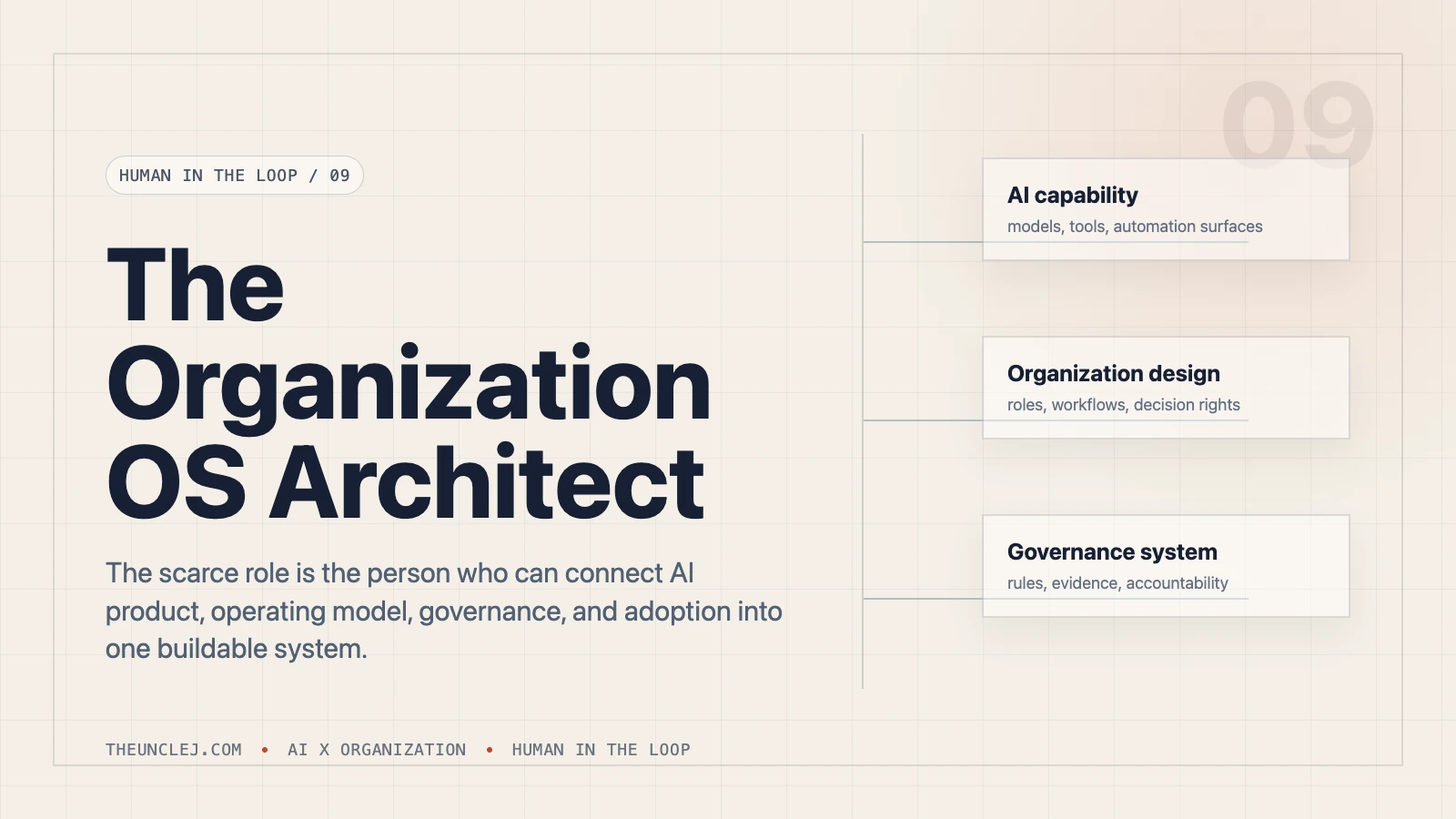
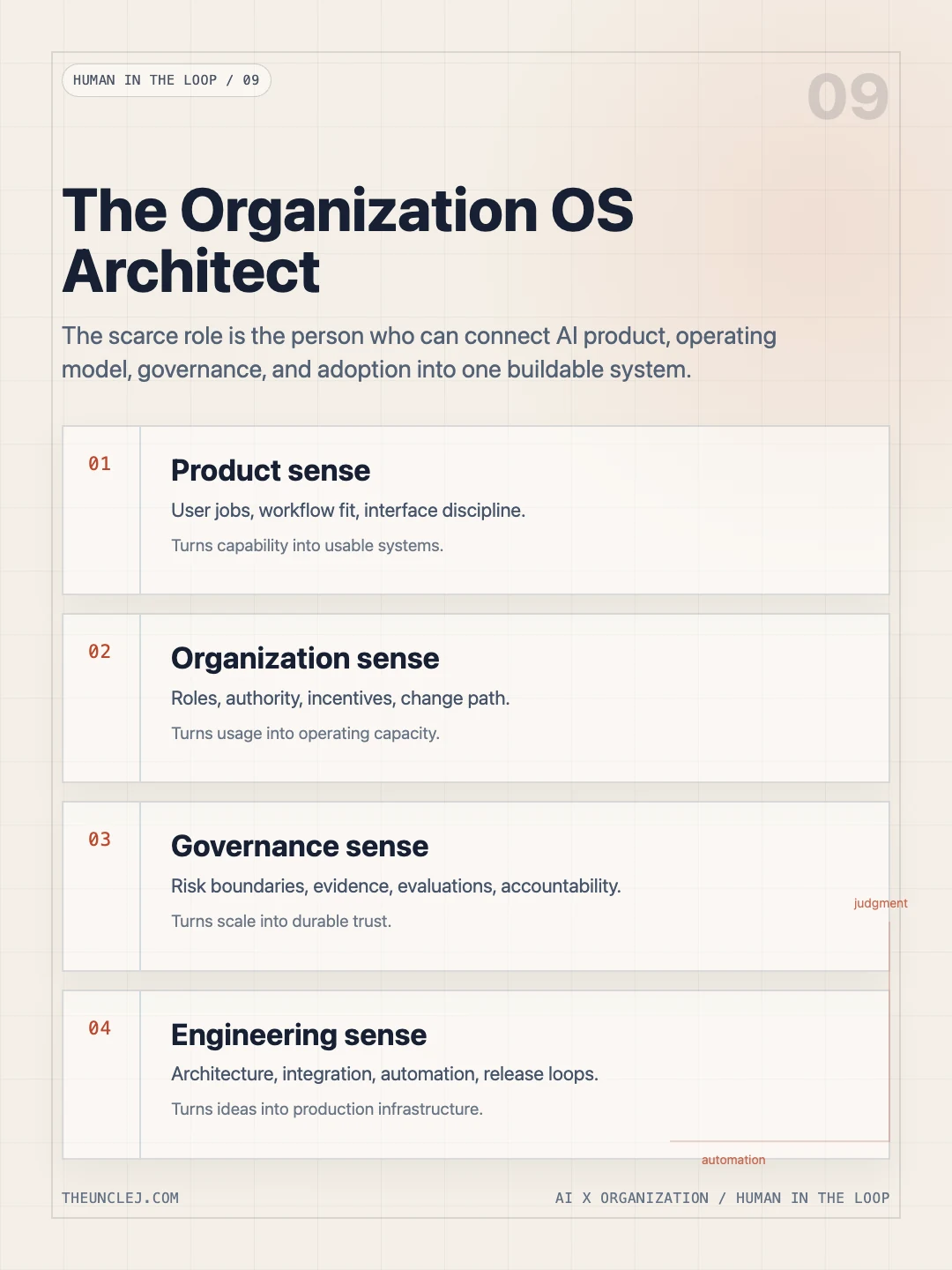
This is Part 9 of the Human in the Loop series.
By the ninth essay, I actually do not want to talk about AI anymore.
Not because AI does not matter.
Because by this point in the conversation, going back to talking about tools feels too light.
The first eight essays put a lot of words on the table. Division of labor. The organization OS. The HR three-pillar model. The new labor contract. The Wulf matrix. The judgment premium. FDE. The A/O/G three cuts.
It looks like a lot of vocabulary. It is all saying the same thing.
AI is not a faster version of the old company.
AI forces you to admit that the old company already had a lot of lines that were never drawn clearly.
Who judges.
Who signs.
Who reviews.
Who pulls the plug.
Who takes the fall.
Who sediments the experience so the next round does not depend on something an old employee happens to remember.
These questions used to be smudge-able. The flow could be a little slow. There could be a few more meetings. The long-tenured employees could absorb a little more. The boss could make a few more gut calls. The company would still run.
The moment AI walks in, the smudging stops working.
Machines do not absorb organizational responsibility on your behalf. Machines amplify the accountability chains you never bothered to write down, and they show them to you at scale.
So if a CEO in 2026 is still only asking three questions — which model do we buy, which agent do we plug in, which system do we deploy — that CEO is still sitting at the tool table.
At the tool table you can do procurement. You can run pilots. You can ship demos.
You cannot build a company.
The real questions sit at a different table.
That table does not ask what AI can do. It asks: what should the company be redrawn into?
How are roles divided. Where do flows break. Where does knowledge sediment. How is accountability traced. Who hands out the permissions. Who can stop it when it goes wrong. How does a pilot get into production. How does production get rolled back.
The head of engineering cannot answer that alone.
The head of HR cannot answer that alone.
The head of digital transformation cannot answer it with a roadmap either.
This is an operating problem.
It is the kind of problem the person at the top has to sign for personally.
But the person at the top signing personally does not mean the person at the top drawing every diagram personally. The company needs someone whose job it is to translate these questions into organizational blueprints, then take the blueprints back to the operating table so the boss can sign, hold people accountable, and run postmortems.
That is the position this closing essay is about.
I am deliberately not in a rush to give it a title.
Giving it a title is easy. The moment you give it a title, it becomes a job description.
The hard part is naming the function clearly.
This position has to translate AI capability into organizational capability. It has to translate model output into business actions. It has to translate business actions into the break points in a flow. It has to translate break points into accountability chains. It has to translate accountability chains into governance gates.
When no role catches this work, the company starts producing a very quiet kind of illusion.
Every department is using AI, and the company as a whole is not getting smarter.
Sales is using AI to write scripts. Customer support is using AI to answer tickets. Engineering is using AI to write code. Operations is using AI to make graphics. HR is using AI to write job posts. Each local pocket looks like it is making progress. Every department head can name a few productivity wins in the quarterly review.
Then the CEO looks at the operating result and sees something else. Cross-functional work is messier. Process accountability is fuzzier. Knowledge is more scattered. Governance pressure is higher.
It is not that AI is useless.
It is that no one turned AI into organization design.
So the ninth essay is not asking whether to adopt AI.
That question is too small for 2026.
The heavy question is this.
AI is already inside. Who is responsible for redrawing the company into an organization that can carry it?
What I want to define is another layer of function in the AI era.
The organization OS architect.
It does not stand on a title. It does not stand on a citation.
It stands on the question itself.
Once AI walks in, roles, flows, knowledge, accountability, and governance all have to plug back into the same organization OS. Whoever draws those interfaces, whoever carries them back to the operating table so the person at the top can sign, hold people accountable, and run postmortems — that person is doing this job.
The phrase "Chief Organization Officer" pulls readers right back toward "upgraded HR head."
I have to dismantle that misreading first.
Read it as upgraded HR and every downstream judgment will skew. You start asking: does this person own recruiting. Does this person own performance. Does this person own training. Does this person own culture. Do they report to the CEO. Are they more senior than the CHO.
These questions are all the wrong shape. They all sound like org chart questions.
But the organization OS architect I am describing is not a box on the org chart. It is a methodological layer.
In traditional organization theory, people have already split the founder-CEO, the Chief Organization Officer, the Chief Human Resources Officer, the level-four HR leader, and the HRD into separate layers. That split has value. It surfaces a lot of conflicts that companies usually cannot articulate.
At level one, the boss is thinking: how does the company survive, grow, and ride out the environment.
At level five, the HRD is thinking: how do we standardize talent, develop common competencies, and operationalize forms and processes.
Neither side is wrong.
They are simply not even debating the same layer of problem.
A lot of what gets called "the boss does not understand HR" or "HR does not understand the business" is not, at its core, a communication problem. It is a missing methodological layer.
What is missing is layer two. How do you build and iterate the organization itself.
In traditional organizations, this gap can be filled by borrowing the "Chief Organization Officer" framing.
But in the AI era, I do not want to keep using the old name.
The old name carries an HR shadow, a CHO shadow, an organization-development shadow. What I am describing is a different thing. After AI enters the organization, the company is missing someone who can rewrite the organization protocol.
That role does not do strategy for the CEO. It does not do the six HR modules. The question it answers is: to realize this strategy, what organizational capability is required; which systems does that capability have to live in; which roles have to be redefined; which flows have to be reconnected; which accountabilities have to be rewritten; which culture slogans have to be translated into mechanisms.
In the AI era, this missing layer becomes more glaring.
AI does not land inside one department. The moment AI moves into production, it simultaneously touches engineering, business, legal, finance, HR, operations, customer support, and sales.
If you put the head of engineering alone in charge, the problem becomes platform construction.
If you put the head of HR alone in charge, the problem becomes training and headcount planning.
If you put the head of digital transformation alone in charge, the problem becomes systems implementation.
If you let the business heads pilot independently, the company sprouts a pile of mutually unaware tools.
Each can show local wins.
The organization protocol layer is still empty.
What is the organization protocol layer.
It is the layer inside a company that defines who can do what, who has to judge what, who is accountable for the outcome, under what conditions everything must stop, where knowledge sediments, and how it is reused next time.
The moment AI walks in, that is the layer that gets hit first.
So the organization OS architect is not an upgraded HR head. It is not a person who draws flow charts. It is the systems architect next to the person at the top. Its job is to plug strategy, AI capability, the business field, the human-machine division of labor, and governance boundaries into the same organization OS.
A note in passing.
"Chief Organization Officer" is not a phrase I invented. Longfor, Fang Shengtao, and that lineage of organization work — I do not need to dance around any of it. I did work inside it. I was trained by it.
But this essay is not about that.
I am not here to write footnotes for old vocabulary. I am not here to find myself a seat inside someone else's framework. I accept the traditional organization map. The new map for the AI era I am drawing myself.
What that traditional school left me with is not a title. It is a few hard reference points.
An organization is not a few people plus a chart. An organization is the dynamic relationship between environmental pressure, strategic choice, system configuration, capability and culture, and outcomes. Any layer where you cut corners eventually shows up in the business result.
Most CEOs talking about AI are still stuck in "find a few people who can use AI," "buy a few tools," "let the departments raise productivity." That is still old organization thinking. Once AI is inside, if you do not look at the system, the capability and culture, and the gap between real and stated goals, the stronger the tools get, the brighter the cracks shine.
AI is not an add-on tool. AI is not just one more piece of software on the employee learning list. AI is a variable in the organizational capability function. The moment that variable changes, the formal organization, the talent, the culture, the flows, the mechanisms, and the systems all have to be rebalanced.
The boss says we are going AI. That sits in the upper third. The employees start using tools. That sits in the lower third. If the middle layer — operating principles, process mechanisms, capability standards — never changes, the organization is still the old organization, and everyone is just holding a faster tool.
So I am not turning an AI essay into an HR essay.
The traditional school already named that gap. What I am seeing now is a different gap, more concrete, more engineered, sitting right next to the operating table of the person at the top.
The old question was how a company moves from gang to organization, from rule-by-personality to rule-by-system, from business success to organizational success.
The new question is how a company moves from a human organization into a human-machine hybrid organization.
That is why I am renaming this position the organization OS architect.
I came out of that system. I am not a recording of it.
Once AI is inside, this gap gets amplified.
The reason is simple. AI does not just add one tool variable. It rewrites five layers at the same time.
The role layer goes first. A role used to be one person, one set of responsibilities, one set of competencies. Now a role starts growing machine actions inside it. The role is no longer a pure-human container. It is a composite of human, AI, rules, templates, and audit.
The flow layer is next. Old flow nodes were connected by human-to-human information transfer, by meeting confirmations, by manager calls. Now AI can directly generate, judge, push, and trigger the next action. The question becomes: which nodes can AI pass through directly, which nodes require a human glance, which nodes need human and AI judging together, which nodes have to stay outside production entirely.
The knowledge layer gets rewritten too. Organizational knowledge used to hide inside human brains, documents, meeting notes, and the felt experience of senior employees. Once AI is in, knowledge starts moving into prompts, rule files, SOPs, retrieval libraries, workflows, and eval sets. Knowledge is no longer "who knows." It is "what can the system call, and how is the call verified."
The accountability layer gets rewritten the hardest. When an employee made a mistake, you could at least trace it to a person, a manager, a flow. With AI in the loop, when the output is wrong, is the person who wrote the prompt accountable, the person who called the system, the person who approved the rollout, the process owner. Without writing this out in advance, everyone has an easy out when something breaks: "I was just using a tool."
The governance layer comes down last. Permissions, audit, rollback, kill switch, production gates, data boundaries — these used to feel like the compliance department's job. Once AI is in production, they become operating problems. One wrong call, one out-of-bounds output, one irreversible automated action can touch customers, revenue, and brand trust directly.
Five layers move at once, and the boundaries of the traditional roles start showing.
The head of engineering can run the model and the systems but cannot necessarily rewrite role accountability.
The head of HR can run people and organization development but cannot necessarily define production gates.
The business heads can run for outcomes but cannot necessarily design cross-functional accountability chains.
Legal and compliance can draw red lines but cannot necessarily translate red lines into daily flow.
So the company ends up in a strange spot. Every role touches part of it. No one carries it whole.
That is the structural gap.
A boss who hand-builds a website with AI and concludes "we can cut a lot of engineering headcount" does not understand AI. He has read action replacement as organization replacement. A team that adopts a pile of AI tools and ends up with broken servers, jammed flows, and customers no one is catching is not too aggressive on AI. The organization protocol layer was never designed.
The rough version is fine to leave out of print, but the judgment stays. If a CEO does not understand the organization and only sees AI replacing actions, the company will be led into a very dangerous kind of recklessness.
This is not just short-term mistakes.
It thins the organization.
Once the organization is thin, the stronger the tools, the more brittle the company.
The closing cannot be a summary.
A summary repeats the previous essays. Closing means showing what those eight essays were actually holding up.
Part one held up the meta claim. AI is a new division of labor, not a new tool. The moment that line does not land, every subsequent conversation slides back into "how do we be more efficient, how do we train people, how do we procure."
Part two held up the organization OS. The Klarna customer-support case, the boss B cognitive trap, the cracks the old flow amplifies under AI — none of it was about whether AI works. It was about whether the old organization can carry AI traffic.
Part three held up the collapse of the HR three pillars. SSC, COE, HRBP — the structure is not valueless, but its interfaces were generated in a different era. With AI inside, knowledge, judgment, and accountability stop flowing naturally through the old three pillars.
Part four held up the new labor contract. Once AI drives the price of actions down, what people and organizations actually have to renegotiate is judgment, accountability, boundaries, and outcomes.
Part five held up the Wulf matrix. HOTL, HITL, HITP, HIC, HAM, HOOTL is not a vocabulary show. It is a reminder to the boss: human-AI relationships have different modes, and you cannot smooth them over with one phrase about being "in the loop."
Part six held up the judgment premium. The cheaper AI gets, the cheaper actions get, the more expensive judgment becomes. The genuinely valuable people are not the ones doing more actions than AI. They are the ones who hold judgment in fuzzy, conflicted, high-consequence scenarios.
Part seven held up FDE. FDE is not a new job-title gimmick. It is a signal that AI companies are writing the customer site, the organization interface, and product capability into the same role. It proves that AI changes more than software delivery. It changes organizational delivery.
Part eight held up the A/O/G three cuts. Claude, OpenAI, and Gemini gave us the external signals. I translated them into action, organization, and governance knives that a CEO can pull out in a meeting. Which knife to cut with first is not a maturity question. It is an operating call.
Eight pillars in one frame, and the picture emerges.
AI is a new division of labor, so the old organization OS jams. The old organization OS jams, so the HR three pillars start showing interface problems. The interface problems surface, so the labor contract has to be rewritten. The contract is rewritten, so human-AI relationships need different modes. The modes get clear, so judgment gets repriced upward. Judgment gets expensive, so organization interfaces like FDE appear. The organization interface appears, so the boss can no longer drive forward with a procurement mindset, and has to judge with A/O/G which cut to make first.
Walk the chain to the end and one empty seat is left.
Who holds that picture.
Not commentators. Commentators talk trend. They do not bear organizational consequence.
Not a single head of engineering. A head of engineering can ship the model and the system. The organizational accountability does not sit only with him.
Not the traditional head of HR. A traditional HR head can drive talent, culture, performance, and organization development. The AI-era organization protocol layer already runs through engineering, product, business, and governance.
Not the boss hand-drawing every flow chart. The boss has to sign, hold people accountable, and call the critical forks. The company cannot run on one person's manual organization design.
So Part 9's answer is not "set up another department."
The answer is: the company needs someone who can draw all eight pillars onto the same picture.
That person may not start with a standard title, but the function has to be clear.
He has to understand division of labor, because AI changes the division of labor. He has to understand the organization OS, because tools entering will hit the old flow. He has to understand the HR three pillars, because knowledge and accountability used to flow through those interfaces. He has to understand the labor contract, because the judgment premium has to land in pay, role, and accountability. He has to understand the Wulf mode spectrum, because human-AI relationships differ by scenario. He has to understand the judgment premium, because action efficiency is not organizational outcome. He has to understand FDE, because the customer site is becoming part of organization design. And he has to understand A/O/G, because the boss needs an order in which to cut.
This is not bragging about a composite background.
This is the composite the work itself demands.
AI merged organizational problems back together. The pieces that used to be scattered across engineering, HR, business, legal, finance, and operations now have to come back to one operating table.
That table needs an organization OS architect.
If this essay is only going to leave a CEO with one handle, I do not want to hand over a competency model.
Competency models too easily turn into recruiting copy.
I will hand over five questions instead.
How are roles divided.
Which roles in the company stay human, which actions can move to AI, which roles become human-machine hybrid. Do not write the JD first. Look at the judgment density, risk consequence, and verifiability inside the tasks. Low-judgment, high-repetition, easy-to-verify actions can go to AI first. High-ambiguity, high-consequence, relationship-heavy judgments stay with humans. The layer in between is where HAM lives.
Where do the flow break points go.
For a given flow, which nodes can AI walk through automatically, which nodes need human confirmation, which nodes need human and AI judging together, which nodes do not go into production. The Wulf et al. 2025 human-AI collaboration spectrum helps here, not for vocabulary, but to make it visible to the boss that different nodes hold different amounts of human judgment.
Where does knowledge go.
Organizational knowledge used to hide inside senior employees, meetings, documents, and chat groups. With AI in, that hiding fails. Knowledge has to move into rule files, prompt templates, brief structures, SOPs, retrieval libraries, eval sets, and postmortem records. Otherwise AI calls fragments, not the organization.
How is accountability traced.
When AI output goes wrong, "the system generated it" is not a sentence. Who wrote the rules, who approved the rollout, who called it, who reviewed, who released, who has the right to stop — all of it has to be written into the accountability chain. Without a chain, the more successful the AI project, the more the incident response looks like a no-man's land.
Who signs governance.
Which scenarios can be piloted, which scenarios go to production, which permissions stay closed, which data does not enter, which actions must have rollback, which evals must pass before launch. That is not a compliance department's after-the-fact audit. That is the operating gate of the person at the top.
Once those five questions are answered, the seat of the organization OS architect grows out of them.
It is not one person covering many things. It is one person responsible for putting these questions onto the same picture, forcing every role to answer inside the same protocol.
The head of engineering answers what the system can do. The business head answers what the result demands. The head of HR answers how roles and capability shift. Legal and compliance answer where the boundaries sit. Finance answers how cost-benefit is accounted. The boss answers whether to sign.
The organization OS architect stitches those answers into the organizational blueprint.
The word blueprint matters.
Without a blueprint, the company runs AI on slogans. One department says we have launched. Another department says efficiency is up. Another says risk is under control. Another says employee acceptance is fine. Every local pocket looks like progress. Taken together, there is no shared structure.
With a blueprint, the boss can ask:
Which layer did this round of AI change. Did the role layer change. Where are the flow break points. Did the knowledge sediment into the system. Was the accountability chain written down. Who signed the governance gate. What metrics do we look at next time.
That is the kind of operating meeting the organization OS architect runs.
Not "should we embrace AI."
But "this round of AI walking into the organization — which picture did we actually redraw."
A company that cannot answer those five questions is not unable to use AI. It can use AI. It can use it loudly.
But noise is not organizational capability.
Organizational capability has to be reusable, accountable, iterable, and risk-bearing. AI projects are no different.
What the boss is really looking for is not someone who can run AI projects. It is someone who can turn AI projects into organizational capability.
This section has to stay restrained.
Closing essays slide easily into self-introduction. Too much self-introduction and the essay collapses.
I will only say one thing. This picture, I am drawing myself too.
I am not standing outside commenting on AI organizations. My path has four pieces in it that happen to compress this work into one place.
Piece one is the traditional organization.
I worked HRBP for a long time inside the Longfor system, and I sat in load-bearing organization seats inside traditional large organizations. That gave me an early lesson. Organizations do not run on kind words. They run on goals, structure, talent, mechanisms, culture, accountability, cadence, and human attention, working together. Any layer you cut corners on comes back in the business result.
Piece two is AI delivery.
I have not only read AI essays. I have not only taken a few courses. I have put AI into real projects, shipped delivery, watched the boss's excitement, watched the team's misreadings, watched the flow break, watched the tool hallucinations, and watched one small action get absorbed by AI without anyone rewriting the accountability chain underneath it.
That is why I have always disliked the lazy phrasing "AI replaces people."
AI can replace actions. AI does not automatically replace the organization. If the organization does not get rewritten, action replacement sometimes pushes problems even deeper.
Piece three is system writing.
Meta_J, to me, is not a flashy AI system. It is more like a small-scale organizational experiment. There are roles, rules, gates, postmortems, error modes, delivery shells, fact-traceability, RED-04, redaction, multi-channel surfaces, illustration pipelines, and a master console.
It is not a perfect system. It exposes problems often. Images overlap. Tone drifts. I misread A/O/G. Fact boundaries need backfilling. The X version is not punchy enough.
Those problems make the same point. An AI system does not run on cleverness. It runs on organization design.
Piece four is real products and real money on the line.
Fairmate, the internal growth system, the writing campaigns, the source-material cards, the public drafts, the X threads, the illustration pipeline — none of these are abstract concepts. They put judgment, delivery, product, content, operations, and governance onto the same table.
These experiences add up to a position I see more clearly each year. In the AI era, someone who understands organizations cannot stop at HR. Someone who understands AI cannot stop at tools. Someone who understands content cannot stop at expression. Someone who understands product cannot stop at features.
The hard part is composing them into a single organizational blueprint.
That is why I am renaming this position at the close of the series.
Not because I want to build myself a fancy label. Not because I want to plant myself inside an existing concept.
Fancy labels are useless. The boss does not pay for a label. The boss pays for a position that solves an operating problem.
For now, I am calling that position the organization OS architect.
It has to do three things alongside the person at the top.
Translate AI capability into organizational action.
Translate organizational action into accountability and governance.
Translate accountability and governance into operating results that can be reviewed.
Take any one of those three away and it is not enough.
Translate only AI capability and you become a tool consultant. Translate only organizational action and you become traditional organization development. Translate only governance and you become a compliance brake. The three together start to look like the organization OS architect of the AI era.
I am not trying to write this as "who I am."
More precisely, I am using this series to force myself to answer: can I actually define this table.
The first eight essays were the eight pillars of the blueprint.
The ninth essay puts me into the blueprint too.
Back to "human in the loop" to close.
It does not mean every step needs a human click. It does not mean wrapping AI in a human rubber stamp.
Human in the loop, properly read, means: the organization cannot hand judgment, accountability, adjudication, and learning out together.
People stay in the loop, not because humans are holier than AI.
But because the organization has to bear the consequences.
The moment the organization stops bearing the consequences, the loop becomes an automated assembly line. It looks advanced. It runs smoothly. Until one day you notice the company has forgotten how to judge.
AI is a new division of labor.
A new division of labor rewrites the organization OS.
A rewritten organization OS needs a new organizational blueprint.
A new organizational blueprint needs the person at the top to sign, and needs an organization OS architect holding the pen for the long run.
In traditional organizations, you can borrow "Chief Organization Officer" as a reference frame.
But I do not want to stop at borrowing.
I would rather name it directly. The organization OS architect.
The point is not the title. The point is whether the company has a role carrying this function.
Without it, AI enters every department but never enters the organization.
With it, AI gets a chance to move from tool to organizational capability.
Human in the Loop closes here.
Humans stay in the loop. That is how the loop stays human.
Read on
- Previous: A/O/G: Three Cuts Into One
- Series hub: Human in the Loop