The Judgment Premium
This is Part 6 of the Human in the Loop series.
The cheaper AI gets, the cheaper actions get
By the end of Part 5, the sentence "AI replaces actions, not organizations" was already wearing thin.
That sentence is only the first cut.
The second cut is harder to hear: the cheaper AI gets, the cheaper actions get; the cheaper actions get, the more expensive judgment becomes.
If a CEO still runs the AI meeting as "which department used how many tools," "do our employees know how to prompt," "can we hire fewer people this year," the meeting is already off. What AI changes is not whether a single action can be done faster. What AI changes is that the action itself is being repriced.
Write a piece of copy. Ship a landing page. Compile a memo. Answer a customer ticket. Generate a snippet of code. All of those used to count as "work." Now they look more like water and electricity: necessary, but no longer scarce. They get cheaper, faster, and easier to hand off to a model, an agent, a template, an automated flow.
That is not a bad thing.
The problem is that a CEO is very easy to misread at exactly this point.
He sees the action get cheap and assumes the headcount is cheap. He sees AI generate code and assumes engineering capability is cheap. He sees AI answer customers and assumes customer support is cheap. He sees AI draft a plan and assumes strategic judgment is cheap too.
That is the action-replacement illusion from Part 5.
The reason Cloudflare's signal mattered was not the headline number of 1,100+ layoffs. The real signal was the founder placing it at the level of "rethinking internal processes, teams, and roles" while also reporting that internal AI usage grew over 600% in three months and employees were running large numbers of agent sessions every day.
That tells you the problem has already left the tooling layer.
When an organization lets AI flood into the workflow, what the CEO has to handle is not "who gets replaced." It is "which actions are no longer worth a human doing, and which judgments suddenly have to get more expensive."
Judgment gets more expensive not because humans are inherently noble.
Judgment gets more expensive because once actions get cheap, the number of wrong actions goes up, and the reach of those actions goes up with them. Errors stop being "wrote one bad sentence." They become "sent to the wrong customer, tripped a production permission, damaged account health, broke trust, triggered a compliance consequence."
Action cost used to be a natural brake.
Now that actions are cheap, the brake has to be moved out of the action and rebuilt inside judgment, accountability, and veto.
So Part 6 stops asking "should the human stay in the loop."
That question is too soft.
Part 6 asks: once AI has crushed the price of actions, does your company still have anyone who can decide which actions should not be done, which actions must stop, and whose name goes on it when something breaks.
That is what I call the judgment premium.
The judgment premium is not "humans matter more"
I do not like the phrase "humans matter more."
It turns into a placebo too easily.
The employee walks out feeling temporarily safe from replacement. The manager walks out feeling humane. The owner walks out thinking the article had a nice posture. Then they go back to the office, the flow stays the same, the permissions stay the same, the logs stay the same, the approvals stay the same, and nothing about the organization that actually needed rewriting got touched.
The judgment premium does not mean that.
The judgment premium means this: once AI can perform a large volume of actions cheaply, the thing that produces real operational difference is no longer "who can execute the action." It is "who can decide which actions are worth doing, which must not be done, which require a human signature, and which require an immediate rollback when they go wrong."
That is not emotional value. That is operating value.
A judgment becomes expensive not because it looks sophisticated. It becomes expensive because of four characteristics.
One: the consequence is irreversible.
A bad internal draft can be edited. An action that touches a customer, a creator, the press, a supplier, a platform account — once that goes out, it is no longer a copy edit. It enters a real relationship and leaves a real trace.
Two: the information is incomplete.
AI is good at generating answers from given material. But most enterprise judgments are not exam questions. They are gap questions. The customer's real intent is half-stated. The market signal is unstable. Internal accountability is not yet aligned. Platform rules only show half their hand. Judgment here is not "compute the answer." Judgment is "decide how to bet under incomplete information."
Three: accountability spills.
An action that looks like it belongs to one role spills into brand, legal, sales, support, engineering, finance, and the owner once something goes wrong. AI speeds up the action. It does not automatically tighten the accountability boundary. The dangerous spot in many companies is exactly here: the action runs faster, the accountability is still stuck in the old process.
Four: average accuracy is not a backstop.
Some tasks are fine at 95% accuracy. Some tasks look terrible after a single error. Customer refunds, production permissions, public-relations responses, hiring offers, contract terms, account outreach — none of those can be evaluated by average accuracy. They have to be evaluated by blast radius.
So the judgment premium is not rhetoric about preserving human dignity.
It is an operating ledger.
The cheaper actions get, the more an organization has to re-flag the nodes that are high-consequence, low-reversibility, high-spillover, low-tolerance. Whoever can identify those nodes, design those nodes, and write those nodes into roles, processes, systems, and audits — that is who actually gets more expensive in the AI era.
The reverse case: an owner who says "I built a website by hand with AI, so I do not need engineers" is not someone who understands AI.
That is someone mistaking action capability for organizational capability.
Pages can be generated. That does not mean the architecture will evolve over time. Code can be generated. That does not mean shipping, monitoring, rollback, security, and the accountability chain exist. Customer service can be auto-answered. That does not mean customer trust auto-repairs.
The starting point of the judgment premium is splitting those things apart.
HITL is not a button. It is three rights.
A lot of people read HITL wrong.
They think Human-in-the-Loop means slapping a "confirm" button after AI output. The model generates first. The human glances. Looks reviewed. Sounds compliant. Looks great in the deck: "critical actions undergo human review."
That is the skin of HITL.
In IBM's own definition, the load-bearing word is not just "human is involved." It is that the human participates in the operation, supervision, and decision-making of an automated system, to safeguard accuracy, safety, accountability, and ethical judgment. IBM ties HITL to human override, audit trails, and external review.
Which means HITL was never a button problem.
It is an organizational power problem.
Wulf and colleagues in their 2025 paper broke the positional question down further: HOOTL is no human in the loop; HOTL is human-on-the-loop supervising from outside; HITL escalates to a human when AI is uncertain; HITP makes the human a mandatory process node; HIC puts the human in command, AI proposes; HAM is human-led with AI as augmentation.
The acronyms are not the point.
The point is that they broke a coarse question into pieces: where exactly does the human stand.
Part 6 pushes one step further: if the human stands somewhere, what right is the human actually holding?
My answer is three rights.
One: the right of judgment.
Who defines what counts as "correct." Not who glances at AI output, but who writes the rule book. Rules are written by humans. AI works under those rules. The moment the right of judgment is delegated to the model's "common sense," the company has effectively outsourced its organizational rules to the training data.
Two: the right of accountability.
After the action goes out, whose name can be traced. Not the abstract slogan "humans are responsible." The concrete question: does the system carry actorId, approved_by, action_hash, logs, approval records. If accountability cannot be traced back to a human, it is not accountability. It is the rhetoric people use just before they shift the blame.
Three: the final veto.
After AI has cleared the action, can a human still stop it. If the human does not nod, can the action enter the queue. When an anomaly appears, does the system silently retry, silently fail, or hand the decision back to a human.
These three rights together are the engineering form of the judgment premium.
The right of judgment decides which actions enter the field of consideration.
The right of accountability decides whose signature is on the action after it ships.
The final veto decides whether the action can still be stopped at the last second.
So HITL is not "the human reviews AI."
HITL is this: once AI has crushed the action cost, the organization places judgment, accountability, and the final veto back into positions that are visible, queryable, and answerable.
If there is only a button — no rule book, no accountability chain, no hard veto constraint — the human is not in the loop.
The human is in the PR statement.
The right of judgment: the rule book lives in human hands
The right of judgment is the easiest to talk about abstractly.
So let me bring it down to engineering.
Inside one internal growth system, when AI does first-pass content review, the model does not get to vibe-check "is this content good" or "should this sentence be sent." The system carries a dedicated rules file and a rule-injection service. Human judgment is written into rules first, then injected into the AI's context. AI works under that rule book.
That looks like a small thing.
It is the dividing line of the right of judgment.
If there is no rules file — only a one-liner "let AI decide whether this is appropriate" — the right of judgment is no longer in human hands. It has drifted into training data, default preferences, and ad-hoc output. The owner thinks he saved himself the trouble of writing a rules document. What he actually saved was the organization's explicit judgment.
Why does explicit judgment matter?
Because "correct" inside an enterprise is rarely "correct" in natural language.
In customer communication, what does not over-promising look like. In creator outreach, what does not-harassing look like. In sales leads, what does high-intent look like. In contract terms, what does acceptable-risk look like. In customer replies, what does both reassuring and not-promising look like. None of these can be reliably inferred from a model's common sense.
These are the company's own operating judgments.
In the old days, those judgments lived inside senior employees' heads, inside a manager's verbal experience, inside the owner's gut-call moments. Once AI enters, those judgments cannot stay hidden. AI does not automatically know your company's boundary. AI just performs the action.
So the first step of the judgment premium is not training more "AI-fluent people."
It is moving the company's judgment rules out of human heads, group chats, and ad-hoc meetings, into a place that is versioned, callable, and reviewable.
When the rule book is in human hands, AI amplifies efficiency under human rules.
When the rule book is not in human hands, what AI amplifies is training data, template bias, and organizational laziness.
A lot of CEOs make an expensive mistake here. They treat rules files, prompt templates, approval guidelines, and exception lists as operational detail to be filled in slowly by the people below.
No.
That is organization design in the AI era.
If your company has not written down what counts as correct, the more capable AI becomes, the faster it drifts. The model is not malicious. The model just never received your company's real judgment boundary.
The right of judgment is not sitting in a meeting room saying "we should be careful."
The right of judgment is: at runtime, the rules AI is reading were written by humans, and that rule set can be updated, audited, and held to account.
That is the first form of the judgment premium.
The right of accountability: write it into the field
The second right is accountability.
This is also where you can tell most clearly whether a company is doing AI organization design seriously.
Plenty of companies say it out loud: "AI is just a tool. The human is ultimately responsible."
That sentence is too light.
The real question is: can the system find that human.
Inside one internal growth system, an advanced-write action does not just slide into the queue. Every action computes an action_hash. The approvals table carries approved_by, expires_at, and similar fields. Action logs record actorId. One action is not "AI sent it" or "ops sent it" in vague terms. It maps back to a specific approval, a specific action, a specific time, a specific person.
That is what the right of accountability looks like.
Accountability is not moral rhetoric. It is a field-level constraint.
If a company says "the human is responsible for AI" but the system has no actorId, no approval record, no action hash, no log, no rollback record — that line is only nice for external messaging. When something actually goes wrong, accountability turns into group-chat archaeology, verbal recall, and mutual blame.
In the AI era, accountability has to be engineered.
Because AI drives the number of actions up.
A human used to send a few dozen messages, edit a few snippets of code, handle a few documents in a day. An agent can now generate in batch, call in batch, organize in batch, reach out in batch. Once action volume goes up, leaning on human memory and managerial experience to carry accountability stops being enough.
Worse, AI-generated actions often cross multiple systems.
One customer reply can touch CRM, contracts, support, and legal language. One code change can touch testing, deployment, monitoring, and rollback. One marketing outreach can touch platform accounts, brand relationships, sales leads, and customer trust.
The action looks like a single line of output. The accountability stretches across several layers.
At this point the CEO has to ask a very plain question: who pays when this breaks.
That sentence is not a hunt for a scapegoat. It is the only way an organization can know how the accountability chain behind each action is designed.
AI can generate content. That does not mean it can sign for it. AI can recommend actions. That does not mean it can absorb a customer complaint. AI can call tools. That does not mean it can be held accountable for permission abuse.
So the second step of the judgment premium is moving the right of accountability out of slogans and into fields.
Who approved.
Who triggered.
Who changed the rule.
Who handled the exception.
Who authorized the rollback.
If the system cannot answer those questions, the CEO should not casually claim the company has done AI automation.
What he may actually have done is hand the action to AI and leave the accountability at the crash site.
The final veto is not clicking confirm
The third right is the final veto.
It is whether a human can say "no" at the critical moment.
This is where fake HITL is easiest to spot. Plenty of systems put up a confirmation dialog and claim there is a human in the loop. But the question is: can that confirmation actually stop the underlying action? Once AI has judged the action good, can a human still hold it back? When the human confirmation is missing, does the task still enter the queue, or does it fail outright?
Inside one internal growth system, real-run write-actions must explicitly carry a confirmation token. Without that token, the task does not enter the queue. The value of CONFIRM_REAL_RUN_SINGLE_TASK is not the string itself. The value is that it turns the final veto into a hard constraint.
The human is not reading a report after the fact.
The human is a door the action must pass through before entering the real world.
That is not the same thing as "human review." Most reviews happen with AI already pushing the flow forward and a human nodding from the sideline. A real final veto requires the underlying flow to admit: if the human does not nod, AI does not move.
Bainbridge's 1983 essay Ironies of Automation gets uncomfortable right here.
She pointed out that one of automation's ironies is this: the more automated the system, the more highly skilled the human you need to take over when something goes wrong. And if the human is never in the loop, that takeover capability decays. Translate that into AI-era organizational language: the more you pull humans out of the flow, the more likely you find — at the moment the human is finally needed — that the organization no longer knows how to judge.
So the final veto is not about slowing things down.
It is about keeping the organization's judgment muscle alive.
If every high-risk action runs automatically by default and the human only shows up to patch the aftermath, the organization slowly turns into "fully automated in peacetime, no one to find during the incident." Looks advanced. Actually brittle.
Real HITL does not deploy the human to clean up after AI fails. Real HITL keeps the human's veto right intact at high-consequence nodes, all the time.
That is why Part 6 has to link the judgment premium and HITL.
The judgment premium does not mean the owner personally reviews every piece of content. It does not mean every flow returns to handcraft. The opposite — low-risk, well-bounded, reversible actions should be automated. Otherwise the organization gets dragged to death by low-value actions.
But high-consequence, low-reversibility, accountability-spilling actions must have a final veto.
That power does not live in the values statement.
It lives in the state machine, in the approvals table, in permissions, in switches, in confirmation tokens, and in rollback paths.
Without those hard constraints, no matter how many times the owner says "the human is in the loop," he is only saying it to himself.
Three replacement illusions
After laying out the three rights, look at a few external signals so the AI-replacement narrative does not carry you away.
The first is the customer-service replacement illusion.
Klarna once told a very loud AI-customer-service story. Press reports cited the equivalent of large amounts of human labor, shorter response times, big cost savings. By 2025, Fortune reported (citing Bloomberg) that Klarna was re-emphasizing the quality of real human support, with the CEO admitting that if cost becomes the dominant evaluation factor, you end up with lower-quality outcomes.
This is not "AI customer service does not work."
More precisely: AI can handle a high volume of low-complexity conversation, but customer support is not just question-and-answer. It also includes reassurance, exception judgment, trust restoration, escalation paths, and accountability. You can replace actions. You cannot pretend trust got replaced too.
The second is the coder replacement illusion.
Incidents like the Replit / PocketOS database wipe sting not because AI wrote one bad snippet, but because once an agent touches production infrastructure, the error stops being a text error. It becomes a business incident. Production permissions, databases, backups, rollback, audit — none of that is something you automatically own just because you "can write code."
Of course an owner who built a website with AI on his own is going to feel excited.
That is normal.
But if the takeaway is "engineers can go," that is not understanding AI. That is not understanding software production. The page is an action. The system is organizational capability. Generating code is an action. Running stably in production, being able to localize and roll back incidents, being able to restore customer trust — those are organizational capabilities.
The third is the software-magic illusion.
TechCrunch reported that Builder.ai entered insolvency, and noted it had long pitched itself as an automated app-development platform while, according to WSJ reporting, relying heavily on human engineers. The value of this case is not to grade a company. It is to remind the CEO: software delivery has never been "generate a page."
Requirements clarification, architecture trade-offs, testing, deployment, ops, customer delivery, change management, the accountability chain — those all sit behind the action.
AI makes the front-stage action look lighter.
The back-stage load does not vanish on its own.
The three illusions share one misread: the CEO thinks he replaced people; what he actually replaced was a single action. He thinks he saved cost; what he may have cut is the quality boundary, production governance, and incident recovery system.
I am not against AI replacing low-value actions.
The opposite. Low-value actions should be replaced.
What is actually dangerous is a CEO who does not understand organizations mistaking action replacement for organizational replacement, mistaking generation capability for delivery capability, mistaking cost reduction for completed judgment.
That company is not more AI-native.
It just handed its blast radius to a cheaper action system.
How the judgment premium lands on the org
Bring it back to the owner's desk.
Part 6 is not asking the CEO to worship "judgment."
Judgment that lives only inside a human head is still old-world mysticism. The judgment premium in the AI era has to land on the organization.
One: draw the judgment flow.
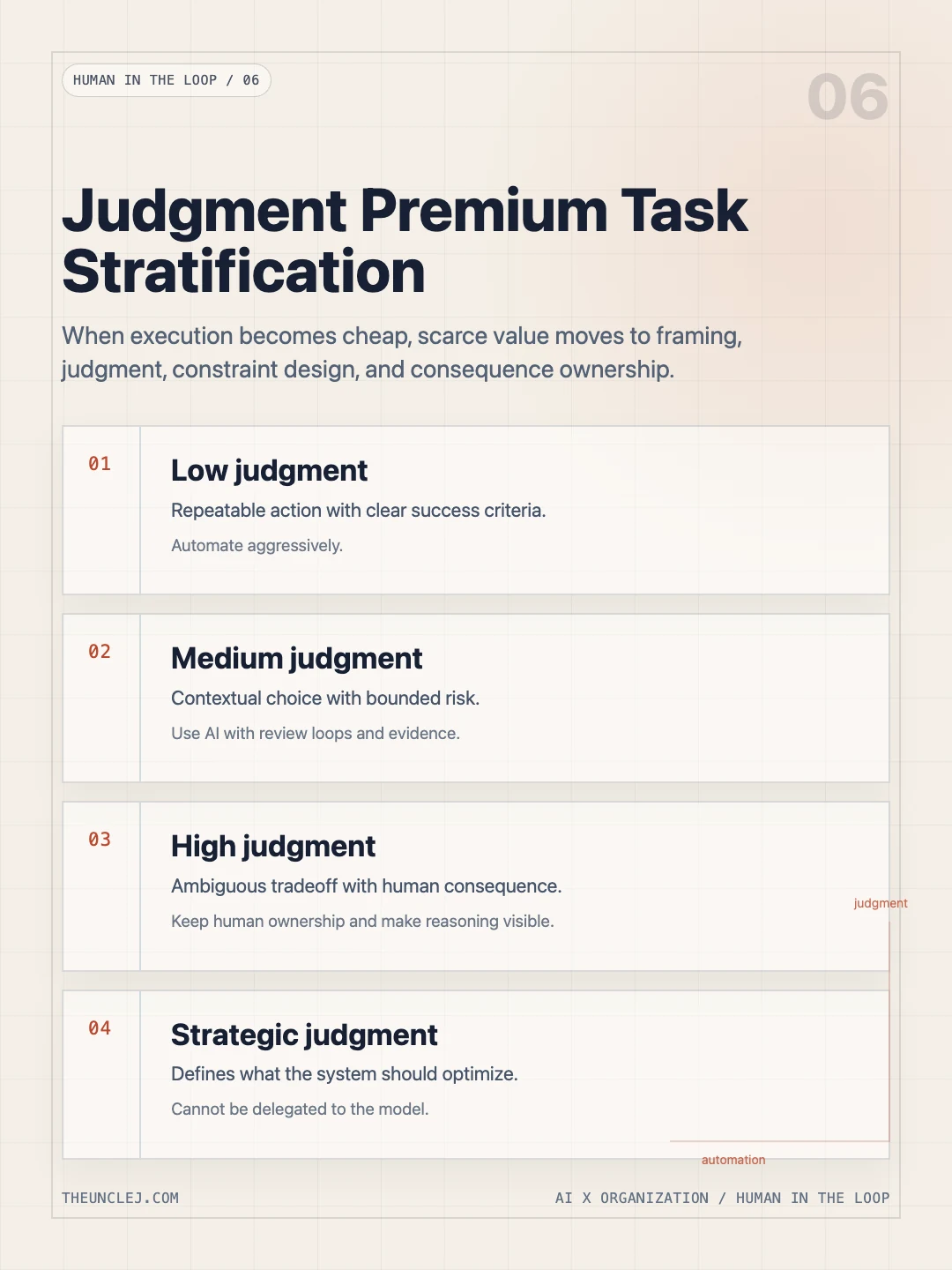
Do not start by asking which roles can be cut. Start by asking which judgment nodes live inside that role. Which actions are pure execution. Which actions change the customer relationship. Which actions touch production permissions. Which actions affect cash, compliance, brand, and long-term trust. Low-judgment actions can be automated. High-judgment nodes must be flagged red.
Two: draw the permission flow.
What tools can AI call. What data can it touch. What systems can it write to. Can it reach external customers. Can it enter production. Can it send real messages. These are not IT trivia. These are operational boundaries the CEO has to sign for.
Three: draw the exception flow.
After AI gets something wrong, who notices, who pauses, who takes over, who rolls back, who tells the customer, who runs the retrospective, who updates the rules. Without an exception flow, the more automation you ship, the easier it is for the organization to lose its voice during an incident.
Four: draw the accountability flow.
Behind every critical action, is there a named owner. Who approves. Who writes the rule. Who triggers. Who clears. Who runs the retrospective. AI automation without an accountability flow always ends up in the gray zone of "everyone participated, no one is responsible."
These four flows together are where the judgment premium lands on the organization.
It is not a training course. It is not an AI usage policy.
It is an organizational rewrite.
The simplest meeting move is to make every business lead bring a single table to the room: which actions were replaced by AI this month, which nodes had to retain human judgment this month, which exceptions occurred this month, which rule was changed this month. If those four columns cannot be filled, the company is not managing the judgment premium. It is just tallying AI usage activity. The operating accountability has not been brought back to the table or the budget.
If a CEO seriously wants AI inside the company, the question is not whether employees can use the tools. The question is: which judgments inside the company are appreciating, which actions are depreciating, which roles have to move from "action executor" to "judgment-node owner," which flows have to move from "human-pushed" to "AI-pushed plus human veto."
That is the door Part 6 leaves open for Part 7.
The judgment premium cannot rest on the CEO alone.
It needs a new role that connects the customer site, the business judgment, the engineering implementation, and the accountability chain. That role is not just an engineer. Not just a salesperson. Not just delivery. Not just a project manager.
It is closer to FDE.
That is what the next piece is about.
Why FDE is not a hybrid of "engineer plus sales," but the organizational carrier of the judgment premium in the AI era.
Because once actions get cheap, what the company is short of is not more actions.
What the company is short of is people who can place actions inside the right accountability chain.
Read on
- Previous: AI Replaces Actions, Not Organizations
- Series hub: Human in the Loop
- Next: FDE Is Not an Engineer. It Is the Organization Interface.